


 [tta_listen_btn]
 April 16 2026

The question of AI adoption is settled. Now, the real focus is on where AI workflow automation can have the greatest impact.
McKinsey’s 2025 State of AI report confirms that 88% of enterprises now use AI in at least one business function. Now, every major enterprise faces the harder question: where exactly to deploy AI, and whether the deployment can actually generate results that move the income statement.
According to Deloitte’s State of AI in the Enterprise 2026 report, which surveyed 3,325 senior leaders, just 16% of organizations have fully redesigned roles, processes, and operating models to integrate AI into how work actually gets done. The other 84% are layering AI onto legacy workflows and wondering why ROI isn’t showing.
The constraint is not the model’s capability, but workflow selection, and the enterprises generating the clearest returns are not deploying AI everywhere. Instead, they are deploying it precisely in workflows where inputs are defined, volume is high, and success criteria can be measured. What follows is a prioritized view of the five workflows and the best AI automation examples.
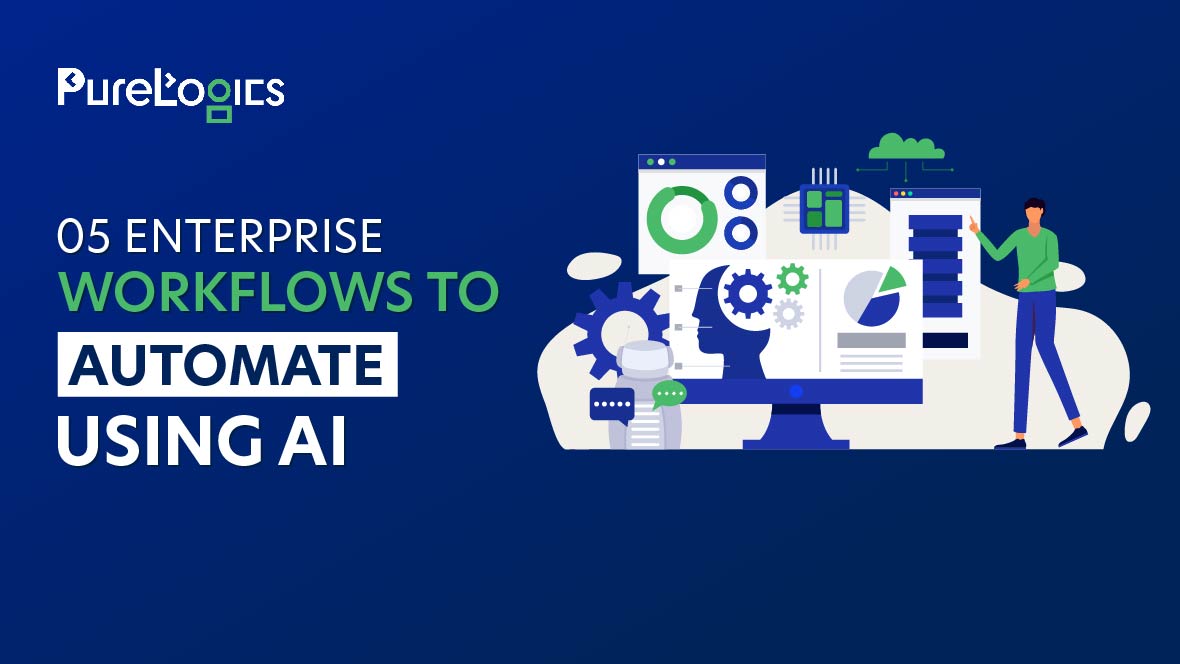
5 High-Impact Enterprise Use Cases for AI Workflow Automation
AI in business operations is revolutionizing the way enterprises streamline workflows, enhance efficiency, and deliver measurable outcomes through intelligent automation.
1. Account Payable and Invoice Pro
Invoice processing is the starting point for enterprise AI automation for a reason. It is high-volume, rule-governed, and historically dependent on manual data entry, which introduces both delays and errors. AI systems can extract data from invoices, cross-reference purchase orders, flag discrepancies, and route exceptions to the appropriate approver without any human intervention. The clear inputs, defined outputs, and sufficient volume generate measurable cycle-time reduction within weeks of deployment.
For example, Uber implemented a GenAI-powered invoice document processing system to handle high volumes of supplier invoices. The solution uses AI models to extract key data from invoice PDFs, validate fields, and route them through approval workflows. As a result, Uber reduced manual invoice processing by 2x, improved extraction accuracy to around 90%, and cut average handling time by nearly 70%, significantly improving accounts payable efficiency.
For CFOs tracking working capital efficiency, this is one of the few automation investments with a directly attributable impact.
2. Compliance Monitoring and Regulatory Reporting
Compliance processes carry a structural burden that most enterprises underestimate: the manual effort required to monitor policy changes, cross-reference them against current operations, and create compliance documentation. AI agents can continuously monitor regulatory feeds, detect relevant changes, and assess operational exposure.
For instance, Amazon uses AI compliance screening and investigation systems to ensure regulatory compliance across its operations. The system automatically screens 2 billion transactions daily against global sanctions lists and compliance rules, detecting potential violations for review. When a case is detected, the AI agent takes over the investigation workflow by analyzing customer identity, name variations, address data, and verification documents, while also pulling information from internal compliance and transaction systems.
Deloitte’s research study titled State of AI in Enterprise, the Untapped Edge states that only one in five companies has a mature governance model for autonomous AI agents, which means the enterprises that build governance infrastructure early are not just reducing compliance risk. They are building a structural capability that speeds up every subsequent deployment.
3. Customer Service and Case Resolution
AI agents can handle complete resolution workflows such as authenticating the customer, pulling account history, determining eligibility, and closing the case. These agents no longer operate as simple chatbots as they orchestrate end-to-end support processes across CRM, billing, and backend systems. This is where AI workflow automation moves from task-level efficiency to full process orchestration, allowing enterprises to resolve cases without human intervention in most standard scenarios.
For instance, DoorDash uses AI agents to automatically handle hundreds of thousands of customer support calls daily. The agent authenticates users, identifies issues, processes refunds or credits, and resolves cases without human intervention, handling a large number of interactions daily. Similarly, Ford Motor Company uses AI agents to assist customers with vehicle information, service scheduling, and diagnostics, enabling faster case resolution and improving support efficiency.
4. Sales Operations and Pipeline Intelligence
AI automation can address two distinct problems: forecast accuracy and sales capacity. On the forecasting side, AI automation can analyze pipeline signals (engagement patterns, velocity, competitive indicators) and produce more accurate committed-call projections than the judgment-based process most companies rely on. On the capacity side, AI agents can execute the administrative workflows that currently consume selling time (CRM data entry, follow-up sequencing, and proposal generation from templates). The mechanism is simple here: when AI absorbs administrative burden, selling capacity increases.
In sales operations, AI workflow automation is increasingly used to convert unstructured pipeline data into structured decision intelligence, enhancing forecasting accuracy and execution efficiency.
For instance, Cisco uses AI agents in its global planning organization to improve demand forecasting across more than 10,000 products and multiple business units. These agents can interpret forecasting questions, select the appropriate predictive model, generate demand forecasts, and explain the factors behind expected outcomes. The agents also automate feature selection, model evaluation, and insight generation, enabling Cisco to scale forecasting across its supply chain while reducing the manual analytics work.
5. Supply Chain Management
AI is rapidly becoming the strategic differentiator in supply chain management by allowing more accurate forecasting and proactive exception management across complex global networks. The research from McKinsey titled Beyond automation: How Generative AI is Revolutionizing Supply Chains states that companies using AI can assess internal demand, external data, and advanced analytics to minimize burden and get insights that internal systems miss, such as predictive documentation handling and route optimization.
For instance, Unilever is integrating AI and data-driven supply chain planning to improve product availability across retail channels. By combining demand signals and sharing operational data with key partners, Unilever enhances forecasting accuracy and ensures products are available at the point of sale, demonstrating practical AI deployment in large-scale supply chain operations.
It is now important for enterprises to understand where AI can help them most, rather than deploying it unthinkingly.
McKinsey’s research study, The State of AI in 2025, is precise about what separates high performers from the rest: they are 3.6 times more likely to pursue enterprise-wide transformation. This means fundamentally redesigning workflows when deploying AI, rather than layering automation onto processes built for a different operating environment. Additionally, Deloitte’s 2025 data makes the cost of delay concrete: 85% of organizations increased AI investments in the past 12 months, and 91% plan to increase them again this year. Enterprises that have been deliberate in their workflow selection are already increasing their operational advantage. The gap between them and the organizations still running pilots is not going to narrow down on its own.
How PureLogics Can Help
PureLogics has spent over two decades helping enterprises move from strategy to production-grade deployment. We understand that adopting AI is not just a technical decision; it’s a business decision and carries real stakes. Whether you are just beginning to explore the possibilities or you are already mid-journey, looking for the right expertise or partner. PureLogics does not just implement technology. We help you build a foundation that scales with your ambitions. Let’s talk about where you stand today and where AI workflow automation can take you tomorrow.
FAQs
1. What is AI workflow automation in enterprise operations?
AI workflow automation is the use of artificial intelligence to automate end-to-end business processes such as finance, compliance, customer service, sales, and supply chain operations. Instead of handling individual tasks, AI systems manage entire workflows by extracting data, making decisions, and executing actions with minimum human intervention.
2. Why is AI workflow automation essential for enterprises today?
Most enterprises are already using AI, but very few have fully redesigned their workflows. However, the right implementation can improve efficiency, reduce manual effort, and increase operational accuracy across core business operations.
3. What are the examples of AI workflow automation?
Common examples include invoice processing, where AI extracts invoice data and matches it with purchase orders. Additionally, compliance monitoring, where AI tracks regulatory updates and detects risks, and customer service workflows, where AI resolves support cases automatically.
4. What is the difference between using AI tools and AI workflow automation?
AI tools typically assist with individual tasks while AI workflow automation connects multiple steps into a complete process. This means instead of just analyzing data, AI systems can execute an entire workflow from input to final output with minimal human intervention.