


 [tta_listen_btn]
 January 1 2026

59% of executives plan to invest in new technology over the next 12-18 months, according to a PwC survey. At the same time, 88% of companies report regular AI use in at least one business function, compared to 78% a year ago. These stats clearly suggest that technology incubation and adoption rates will increase. Therefore, organizations with innovative cultures will get more value from strategic technology investments than their peers do (McKinsey).
Moreover, the difference between breakthrough innovation and an expensive experiment lies in the strategic decisions executives make when evaluating and adopting tech. Plus, C-suite leaders face significant pressure to adopt next-generation technologies, with unclear ROI and organizational resistance.
But organizations that prioritize the adoption of next-generation technology will stay ahead of their peers, and key market studies and analyses clearly indicate this.
Key Market Indicators for Next-Generation Tech in 2026
- The autonomous AI agent market could reach $8.5 billion by 2026 (Deloitte).
- The emerging market for AI/generative AI-related services will be worth more than $200 billion by 2029 (McKisney).
- The global advanced technologies market (covering AI, IoT, and related innovations) is expected to expand from about $677.4 billion in 2025 to over $1.5 trillion by 2035 (Market Research Future).
The rise in the market value of these stats clearly indicates that these next-generation technologies will be part of businesses.
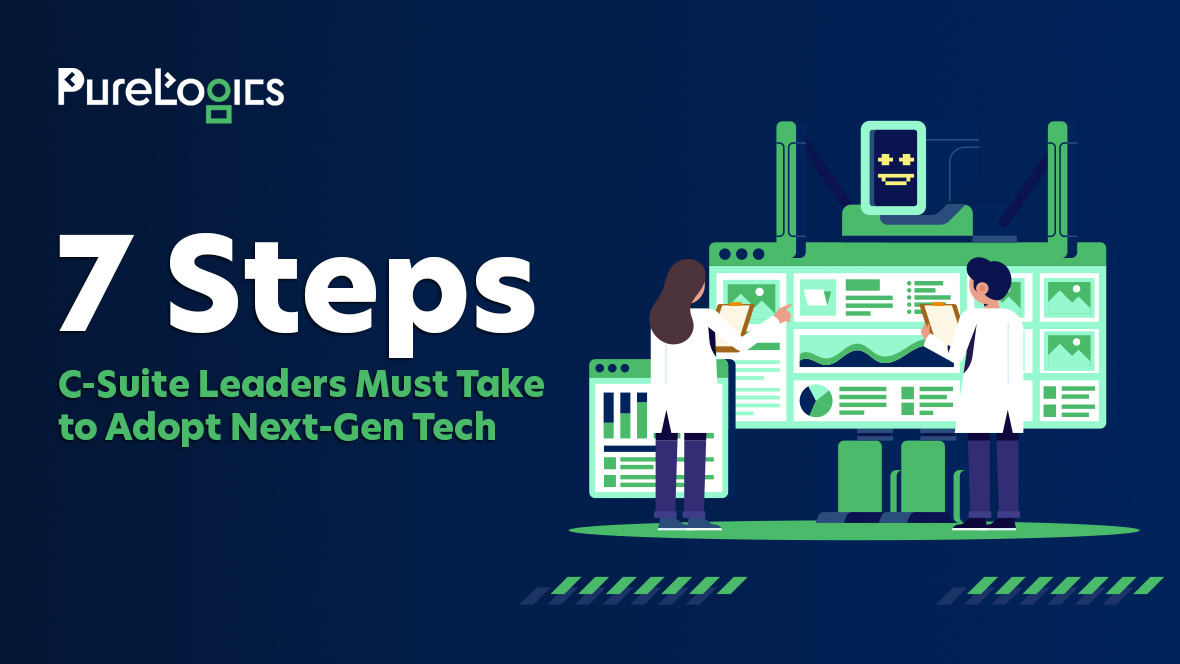
Hence, this blog presents the seven steps C-suite leaders need to take to ensure effective adoption of next-gen tech.
7 Steps C-Suite Must Follow in Adoption of Next-Gen Tech [2026]
1. Assess Emerging Technology Readiness
Before allocating a budget, executives need to assess both organizational readiness and strategic alignment. Additionally, unlike other technologies with proven implementation patterns, emerging technologies require rigorous planning and capability assessment. Below is the framework for assessing next-generation readiness.
Assessment Framework
| Dimension | What to Ask | Why it matters (Value) |
|---|---|---|
| Tech Foundation | Do we have cloud-native infrastructure, API architecture, and integration capabilities to deploy emerging tech rapidly? | Reduces deployment time from 18–36 months to 6–12 months, lowers integration risks, and protects existing technology investments |
| Data Readiness | Do we have quality, accessible, and compliant data for AI and analytics? | Enables accurate AI insights, speeds up innovation, and ensures regulatory compliance |
| Talent & Culture | Do we have skilled teams, change management capabilities, and an experimentation culture? | Ensures successful adoption without disrupting operations and reduces resistance |
| Strategic Clarity | Are use cases clear, aligned with goals, and prioritized by ROI? | Focuses budget on initiatives that deliver measurable value |
| Risk & Governance | Do we have frameworks for security, compliance, and ethical AI? | Prevents data breaches, avoids regulatory penalties, and protects reputation |
| Measurement & Learning | Can we measure outcomes, track performance metrics, and store learnings from both successes and failures? | Enables rapid iteration, optimization, and builds sustained innovation capability |
Without alignment with business objectives, technology initiatives fail to deliver tangible value. All in all, organizations are more likely to achieve a competitive edge when their technology decisions align with their business goals.
47% of projects fail to meet their goals due to weak alignment between technical and business needs.
Source: B2B Reviews
Executive Action: It is best to evaluate the readiness for next-generation technology inclusion, focusing on data maturity, technical capabilities, and organizational culture. As an executive, it is better to engage a specialized technology company to both assess readiness and accelerate integration, ensuring faster value realization and reduced implementation risk.
2. Develop a Next-Gen Technology Investment Decision Framework
The criteria for evaluating next-generation technology differ from those for established solutions, and standard ROI calculations fail to create competitive positioning value.
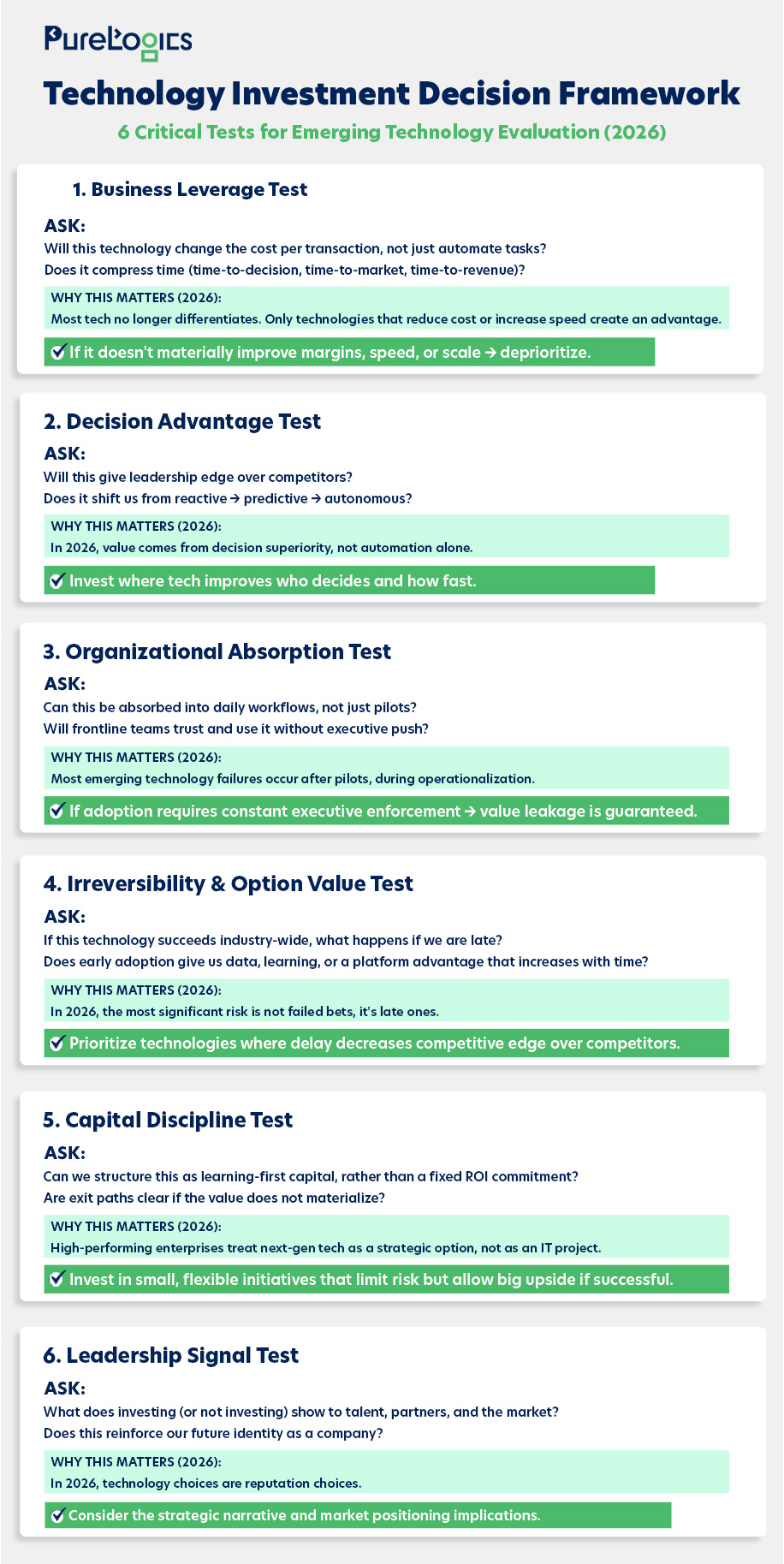
Executive Action: Start by establishing a technology investment team that can evaluate unproven innovations and create a set of criteria that ensures long-term ROI.
3. Deploy AI and Generative AI for High-Impact Use Cases
Artificial intelligence, especially generative AI and agentic AI, is a top priority for companies. As per McKinsey’s latest study titled “The state of AI in 2025: Agents, innovation, and transformation,” based on a survey conducted among respondents from different industries, reported that 23% of organizations are scaling an agentic AI system somewhere in their enterprises (that is, expanding the deployment and adoption of the technology within at least one business function).
However, successful deployment requires strategic focus on specific, high-value use cases rather than broad experimentation.
AI Implementation Approach
| Phase | Timeline | Key Activities |
|---|---|---|
| Phase 1: Case Selection | 1–2 Months |
|
| Phase 2: Proof of Concept | 3–6 Months |
|
| Phase 3: Deployment | 7–12 Months |
|
| Phase 4: Production Scaling | 13–24 Months |
|
33% of organizations have scaled AI beyond pilots, meaning most still have the chance to gain a competitive edge (McKinsey).
But deploying AI is a systematic process, and any mistake can lead to the wastage of investment and time. Some of the common pitfalls to avoid are given below:
- Starting with complex use cases before strengthening the basics.
- Insufficient change management and user adoption plan.
- Lack of integration planning with existing systems.
It can be a hassle for companies to ensure data readiness and to deploy AI on their own; that’s why 61% of companies are now looking to partner with technology providers to integrate generative AI effectively (McKinsey).
Deploying Next-Gen Technology Doesn’t Have to Be Complex
Doing it alone can stall your technology adoption, leaving competitors a step ahead. Partner with PureLogics to deploy AI faster.
Executive Action: Initially focus on 2-3 use cases that can deliver high business value, organizational readiness, and make a structured approach.
4. Build vs Buy vs Partner Decisions for Emerging Technologies
Deciding between build, buy, and partner can be a dilemma for enterprises and small companies. Plus, the rapidly changing vendor market, shortage of specialized talent, and technical uncertainty require strategic thinking. Below are conditions that can help decide between when to build, when to buy, and when to partner.
When to Build
- Looking to create a competitive edge
- Deep integration with proprietary systems is required
- High security, data protection requirements, controlling data, and reducing breach risk are critical
When to Buy
- Faster time to value is a strategic priority
- Commercial solutions are enough to meet business requirements
Partner
- Speed to market is a strategic priority
- No commercial solution meets core business requirements
- Require scalability and compliance through robust architectures
- Specialized expertise is required in low-budget and without long-term commitment
All in all, enterprises can choose to build, buy, or partner, depending on strategy, resources, and desired speed of adoption. Moreover, the table below can further help make a decision.
| Factor | Build | Buy | Partner |
|---|---|---|---|
| Time to Value | 18 to 36 months | 6 to 12 months | 9–18 months |
| Technical Risk | Very High | Medium | Low |
| Flexibility | High | Low | High |
| Best for | Core IP creation | Proven use cases | Strategic innovation |
5. Hybrid Approach for Emerging Technologies
Another approach that is gaining momentum nowadays is a hybrid approach in which companies buy foundational platforms and build differentiated applications on top of them. Then partner for specialized capabilities, such as implementation. This approach balances speed and cost while reducing risk.
Executive Action: Start by assessing your needs, avoiding default build decisions, and choosing the approach that guarantees the desired outcomes.
Not Sure Whether to Build, Buy, or Partner?
Let us assess your technology needs and guide you toward the most effective approach.
6. Establish Next-Generation Technology Performance Metrics
In implementing next-generation technologies, traditional ROI calculations often fail to deliver results and establish strategic positioning.
Emerging Technology Performance Framework
1. Proof of Concept (Months 1–6)
- Validate technical feasibility & model performance
- Confirm data availability & quality
- Test initial value hypotheses
- Secure stakeholder alignment
- Identify risks & mitigation
2. Pilot (Months 7–18)
- Limited-scope deployment
- Achieve user adoption & satisfaction
- Demonstrate measurable business value
- Resolve integration challenges
- Define scaling plan
3. Production (Months 19–36)
- Full-scale deployment across the organization
- Meet adoption & engagement targets
- Deliver projected business impact
- Track ROI vs. expectations
- Establish operational stability & governance
Executive Action: Develop measurement dashboards accessible to the C-suite showing both quantitative and qualitative metrics.
7. Build a Continuous Innovation Capability
Technologies like AI/ML evolve rapidly, and organizations need an ongoing ability to experiment and adapt. Although the one-time initiative can create a temporary advantage. However, continuous success depends on sustained innovation capability.
Executive Action: Create processes for experimentation and scaling, and ensure these processes can withstand economic pressures.
Positioning Yourself for What’s Ahead
The adoption of next-generation technology is one of the most impactful decisions. Organizations that adopt strategically, with rigorous measurement and realistic expectations, will consistently outperform those driven by hype and the fear of missing out. Partnering with PureLogics helps turn technology investments into sustained business advantage with expert guidance on strategy, adoption, and scaling. Book your 30-minute free consultation with our experts.
Frequently Asked Questions
What are next-generation technologies?
The technologies such as AI, IoT, 5G, quantum computing, and robotics that aim to improve efficiency and offer new solutions are known as next-generation technologies.
How can startups and SMEs ensure the adoption of new technology?
The startups and SMEs can follow these steps for the flawless adoption of technology:
- Becoming aware of new technology
- Testing technology on a micro-level
- Make a business case and a budget
- Piloting, observing, and making changes
How can a business prepare itself for technological advancements?
To prepare themselves, businesses should keep learning and upskilling their teams, invest in research and development, and stay flexible. Working with a technology company can also help in the effective planning and implementation of technologies.