







Episode Summary
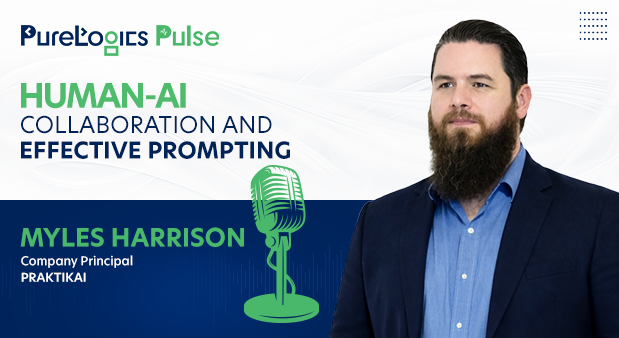
In this episode of PureLogics Pulse, host Mohsin Ali speaks with Myles Harrison, Company Principal at PRAKTIKAI, about the evolving dynamics of human-AI collaboration and what effective prompting really means in practice.
Drawing on nearly two decades of experience in data, AI, and leadership roles across consulting, community building, and applied AI, Myles reframes prompting as context engineering rather than a set of shortcuts. The discussion spans how organizations are moving past AI hype toward pragmatic adoption. Plus, why human oversight remains non-negotiable, and how leaders can position AI as a force multiplier rather than a job threat.
Show Notes
- Human-AI collaboration has changed with generative AI, enabling conversational, iterative, and multimodal workflows rather than static system interactions.
- Prompting is not a technical trick; it’s a collaboration skill rooted in context, clarity, and iterative guidance.
- AI delivers the most value when positioned as a force multiplier that automates low-level knowledge work while humans retain judgment and accountability.
- Too much trust in AI creates fragile systems, and too many restrictions push users to work around the rules, slowing innovation. Balance is key.
- Agentic tools can speed up development, but require strict boundaries, modular execution, and strong human oversight.
- Clear education and transparent communication are crucial to build trust in AI and address fear, resistance, and misinformation.
- AI adoption should start with clear business use cases, clean data, and organizational readiness.
- As AI becomes more proactive, human oversight and critical evaluation remain essential to manage risk, bias, and accountability.
- Explainability, evaluation, and trust will be defining challenges as organizations scale AI from MVPs to production environments.