







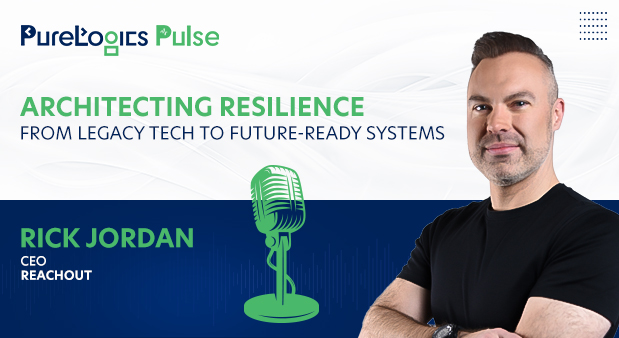
Episode Summary
In this PureLogics Pulse episode, host Mohsin Ali speaks with Rick Jordan, CEO of ReachOut, about scaling companies without collapsing under technical complexity. Rick recounts taking a company public through a reverse merger connected to Yuengling’s Ice Cream Corporation, outlining the regulatory cleanup and financial discipline required to access public markets.
The discussion centers on standardization debt and how inconsistent systems undermine scalability, with Southwest Airlines highlighted as a model for operational simplicity. On AI adoption, Rick stresses organizing data before deploying tools, focusing on structured collection, modern storage, and clear business objectives. The episode concludes with leadership lessons on speed, delegation, and building resilient systems from day one.
Show Notes
- Scalability depends on operational standardization, not just headcount growth.
- Reverse mergers provide a path to public markets but require balance sheet cleanup and regulatory discipline.
- Standardization debt accumulates when organizations allow uncontrolled technology variation.
- AI effectiveness begins with structured data collection and modern data architecture.
- Vector based storage and organized pipelines enable advanced AI use cases.
- Speed often outperforms perfect planning in leadership and technical execution.
- Clear separation of roles in systems and teams creates resilience and long term scalability.