


 [tta_listen_btn]
 March 9 2026

The conversation about AI has shifted in 2026. What was once a chorus of optimism and AI evangelism has now given way to careful evaluation. Demanding rigor over hype, and for executives navigating this scenario, the most dangerous position is not ignorance but moving without direction or a clear AI roadmap.
Therefore, the organizations that will gain the greatest and long-term AI benefit will be those that move decisively yet strategically.
In this piece, we will outline a practical roadmap for effectively implementing AI and generating maximum value for your enterprise, startup, or SMB.
The Illusion of Readiness
Across the enterprises and growth-stage startups, there is a persistent gap between AI ambition and AI readiness. Leaders are increasingly investing in tools and commissioning pilots while announcing initiatives. However, after six to twelve months, many find themselves at a point where their AI investment is no longer useful, or their pilots are not progressing to production. The stats below also paint a stark picture of employees’ unpreparedness and the overall culture.
- 76% of executives believe their workforce is AI-ready. Only 31% of employees agree (Harvard Business Review). It is a strategic blind spot, and decisions being made at the top about AI deployment are disconnected from operational reality on the ground. That disconnect is where AI initiatives quietly die.
- Only one-third of organizations have scaled AI enterprise-wide, despite 88% deploying it in at least one function (McKinsey). The gap is not technological; it is structural. Most enterprises are running AI in isolation, without the data governance or cross-functional alignment required to move from pilot to production.
- 95% of AI pilots fail (Forbes), not because the technology underdelivers, but because the business problem was never precisely defined. A pilot without a measurable success metric and a fixed timeline is not a pilot. It is an experiment with no exit condition.
Every one of these numbers points to the same problem. The enterprises’ AI strategy is not failing because they lack ambition. They are failing because ambition alone cannot hold the weight of execution.
Although it is also important to understand that the sophistication of the models does not measure AI readiness, but rather the maturity of the foundation beneath them. Such as data governance, organizational alignment, process clarity, and the capacity to absorb change at scale. It is important that every C-suite does an honest AI assessment across workflows, data infrastructure, and explainability and validation standards.
Fast-Track AI Success with Expert Assessment
Schedule your personalized AI assessment and discover how to implement AI strategically, without wasted spend or stalled initiatives.
Time to Rethink AI Investment
Leaders treat AI like a magic layer, as a product you buy once, and its value spreads everywhere on its own. That’s not how it actually works, and the enterprises getting the best results are those that are laser-focused. They do not deploy AI to fulfill vague goals like boosting productivity; instead, they deploy it to solve a specific problem.
For instance, cutting contract review from 20 days to 5 days, resolving customer issues faster, or catching supply chain problems three days earlier than before. That precision is exactly what we brought to Legal Breeze. They were losing clients not because of service quality, but because of engagement gaps their existing systems could not diagnose. Our AI engineers identified the specific operational failure, built an AI-powered CMS around it, and the results were unambiguous: client engagement up 10x, errors down 40%.
The starting point should never be, “Which tool should we buy?” It is always what is the one bottleneck costing us the most, and can AI solve it better than anything else we have tried? If you have that answer, the roadmap below will show you exactly what to do next.
Pragmatic AI Roadmap for Executive Leaders
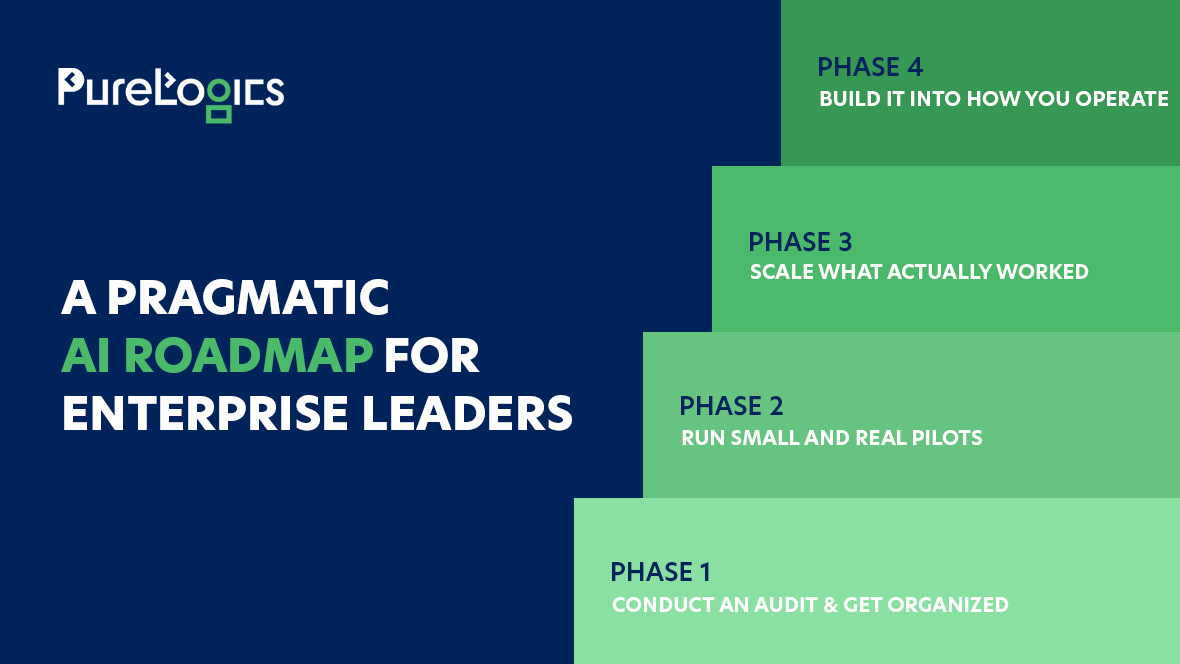
The executives should start by assessing their readiness and running small AI pilots to address key business problems. Then expand successful pilots and integrate AI into regular operations. Moreover, the roadmap below is built on one principle: each phase de-risks the next. There is no skipping ahead or taking shortcuts to production. Here is how it works.
| Phase | Key Actions | Time Duration |
| Phase 1 | Conduct an audit & get organized | 1-3 months |
| Phase 2 | Run small and real pilots | 3-6 months |
| Phase 3 | Scale what actually worked | 6-9 months |
| Phase 4 | Build it into how you operate | 9-12 months |
Let us define these phases in detail so that you can see what each phase contains and how to progress effectively from start to finish.
Phase 1: Mandatory Audit & Get Organized
Most AI initiatives fail before they begin, not in execution, but in assumption. Leaders assume their data is cleaner, their processes more defined, and their workforce more prepared than they actually are. This phase exists to replace assumptions with facts.
Before deploying any AI tool or platform, audit three things internally. First, is your data clean and accessible? Secondly, do your employees have working knowledge of AI? Thirdly, are your processes clear enough to automate? Most of the enterprises miss this and waste months on pilots that go nowhere.
From there, choose two to three real business problems that are costing time and money. Do not focus on broad goals like improving efficiency; instead, narrow them down with AI. Something like our sales team spends 6 hours a week on manual reporting, or customer complaints take 5 days to resolve. These become your AI targets, and your job now is to assign an owner to each and set a measurable goal for each.
Phase 2: Run Small and Real Pilots
A pilot isn’t about proving AI works in general; it’s about proving it works for your problem, within your operational constraints.
Deploy AI only against those defined problems. Measure results weekly. If something is not working after 8 weeks, stop it; do not extend it in the hope that it improves. The discipline to kill a failing pilot and redirect is not a setback. It is the decision that keeps your broader strategy intact.
Phase 3: Scale What Actually Works
Scaling prematurely is how enterprises burn resources without building real capability. So, take the pilots that have worked and expand them, and use the evidence from those wins to set your budget. This is how each AI win will fund the next.
Phase 4: Build It into How You Operate
AI treated as just another project will be ignored or delayed whenever something more urgent comes up. Therefore, integrating AI should not feel like a project; it should be part of how decisions are made and how workflows run. It is mandatory to implement governance and to oversee what AI can and cannot do, and how you can stay compliant.
2026 Is The Year To Re-Build AI Strategy Beyond Hype
This year, AI evaluation matters more, and honestly, the real question is no longer ‘can AI do this?’ but is it helpful in fulfilling enterprise goals?’ Or how effectively it can serve the intended purpose. This is not the year to integrate AI for the sake of AI, and what differentiates leaders from followers in this new phase is clarity.
As an executive, you need to know exactly what you want AI to do and have a concrete roadmap to get there, rather than a vague ambition. If you want, our AI engineers can help you develop an air-tight strategy, just as they did for LegalBreeze and Nable AI. From strategy to development, they handled everything.
Book a free 30-minute consultation with our AI experts and walk away with the clarity your strategy needs.
Frequently Asked Questions
What is the biggest mistake enterprises can make when starting with AI?
The most costly mistake an enterprise can make is to authorize AI adoption without anchoring it to a defined business objective. It is important to invest in tools after identifying the problems worth solving, taking ownership, and setting success metrics. Without broad-level governance, cross-functional alignment, and a clear framework for measuring outcomes, even massive and technically capable AI initiatives can fail to scale.
How to know if an organization is truly AI-ready?
AI readiness is a leadership-level question before it is a technology question. Beyond access to advanced models, readiness requires clean and well-governed data. Most importantly, the workforce must be equipped to use AI responsibly within defined boundaries.
Should AI be developed in-house, or is it better to work with an external partner?
Building AI in-house can be expensive and time-consuming, especially when sourcing skilled talent and developing robust data and MLOps capabilities. The McKisney survey of US executives in 2025 also found that 61% prioritize partnerships with third-party vendors to create customized AI solutions, highlighting the efficiency and expertise that external collaboration can bring.
What is the best way to ensure that AI projects actually deliver ROI?
Begin with one measurable business bottleneck, define a success metric upfront, and run small and focused pilots. Then track weekly progress and halt initiatives that do not deliver results within the defined timeframe. Additionally, scale only what works and embed governance to ensure AI effectively supports enterprise goals.
What is the impact of AI on the workforce?
AI changes how work is done by taking over repetitive or routine tasks and helping employees complete tasks faster. However, some roles may be reduced while others require new skills to work alongside AI. Also, enterprises that provide training and support for employees witness smoother adoption and better results from AI initiatives.