







Episode Summary
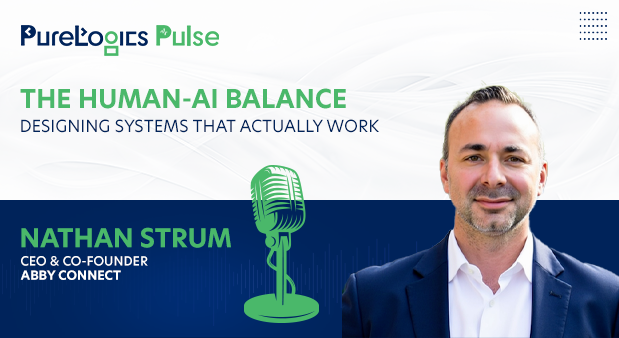
In this episode of PureLogics Pulse, host Amir Khan speaks with Nathan Strum, CEO and Co-Founder of Abby Connect, about how businesses can balance human talent with AI driven systems. Drawing on over two decades of experience in customer support, Nathan explains how Abby Connect evolved from a traditional answering service into a premium communication platform that integrates both human and AI powered solutions. He shares insights from their “Stop Firing Humans” campaign, which challenged the growing trend of automation first thinking and sparked conversations around responsible AI adoption.
The discussion explores where AI delivers the most value, such as handling repetitive workflows and improving operational efficiency, while emphasizing that human interaction remains essential in emotionally sensitive and complex situations. Nathan also addresses common misconceptions around AI, particularly the idea that it is purely a cost cutting tool, and highlights the importance of reinvesting efficiency gains into people and growth. The episode underscores that successful AI adoption depends on thoughtful implementation, continuous experimentation, and aligning technology with real customer needs.
Show Notes
- AI should be used to enhance human capabilities, not replace them entirely.
- Customer experience design should start with human needs, not technology capabilities.
- Automation focused solely on cost cutting can lead to long term brand damage.
- AI is highly effective in handling repetitive and complex operational tasks like scheduling.
- Human interaction remains critical in emotionally driven and high complexity scenarios.
- Successful AI adoption requires a balance between cost optimization and reinvestment in people.
- Organizations should introduce AI gradually through experimentation rather than large scale deployments.
- Upskilling employees early helps reduce fear and builds long term adaptability.
- Customer feedback can be effectively captured and analyzed using AI to improve product development.
- Transparency in AI interactions builds trust and shapes how customers respond to automated systems.