


 [tta_listen_btn]
 April 1 2026

The data is no longer ambiguous. According to McKinsey, State of AI Survey 2025, the majority of enterprises are still in the experimenting or piloting phase, with approximately one-third reporting that their companies have begun to scale their AI programs. The gap in AI automation for enterprises is not a technology gap; the AI models are mature, the platforms are available, and implementation partners are in place. The gap is a decision gap.
All in all, enterprises are stuck not because AI does not work. It is because leadership cannot agree on where to begin. This indecision costs more than most executive teams realize, as every quarter spent in pilot mode results in increased spending on manual processes.
And on top of that, McKinsey’s report titled Agents, Robots, and US, found that 57% of current US work hours could already be automated using technology available today. That is not a forecast; it is a measurement of what is technically possible right now.
So, the question for C-suites in 2026 is not whether to automate. It is where to start in a way that generates credible returns, builds organizational confidence, and lays the foundation for the enterprise-wide scale.
But starting well is rarely a purely analytical decision. Most C-suites face an equally important internal challenge: aligning a leadership team that has different risk tolerances, competing budget priorities, and varying levels of AI confidence. The executives who move fastest are not necessarily the ones with the clearest technology vision. They are the ones who build internal consensus around a single starting point before any deployment decision is made. That consensus, not the AI system itself, is what determines whether the first deployment is successful or becomes another stalled project.
The Wrong Way to Choose a Starting Point
The key here is that, before deciding where to start, it is worth examining where most enterprises go wrong. The two most common failure patterns are opposite in nature but similar in outcome.
- Automating without a plan, which produces working demos with unimpressive results.
- Choosing the most complex, high-visibility workflow in the organization because the ROI potential looks good (on paper).
Both points above share a common flaw: the starting point was chosen before the problem was defined. Enterprises that generate real returns start by identifying where manual operations are most expensive and then work backwards to what AI can address.
Framework for AI Automation for Enterprises: Choosing Where to Start
The highest return points for AI automation share four characteristics, and using these as a filter before any deployment decision can be helpful.
- High Volume: The workflow regularly processes a large volume of transactions, requests, or cases. Consider this or not, but volume is what makes the science of automation work; the efficiency gain on a single instance is meaningless, whereas the efficiency gain across 50,000 monthly instances is material.
- Measurable Outcomes: The workflow has clear success criteria that can be determined before deployment and tracked after. Cycle time, error rate, resolution time, and escalation volume are metrics that make AI deployment an ROI case.
- Structured Inputs: The data feeding the workflow should be clean and consistent so AI can use it easily. This essentially means that data with sufficient structure is required, because workflows built on unstructured, inconsistent, or poorly labeled data require data readiness before automation delivers results.
- Existing Workflows: Running AI operations alongside the existing workflows and processes while monitoring outputs without any disruption. This is how enterprises can detect edge cases and refine their processes before full automation.
In most enterprises, the most expensive manual operations are finance operations, supply chain management, customer service, compliance and regulatory reporting, HR, and operations.
Big Names Using AI Automation
The enterprises generating the most credible results in 2026 are not conducting experiments; they are running production systems in operational areas. For instance:
- Ford is using AI agents to speed up vehicle design and engineering workflows that require hours of manual effort. Again, the starting point was not the most glamorous application of AI in automotive; it was the most repetitive one.
- DoorDash deployed a voice agent using Amazon Bedrock and Anthropic’s Claude that handles hundreds of thousands of support interactions daily, maintaining response latency at or below 2.5 seconds.
Another example is Deutsche Telekom’s adoption of this approach, which has demonstrated measurable business impact. Moreover, the pattern across all is consistent: the starting point was a workflow that was painful, repetitive, and measurable.
Is Your Enterprise Leaving Automation Opportunities on the Table?
Find out exactly where AI can eliminate costs, reduce errors, and free up your team with an AI automation assessment in your specific workflows.
Four Conditions That Must Be in Place Before You Begin
Most AI deployments fail not because the technology doesn’t work, but because the environment around it isn’t ready.
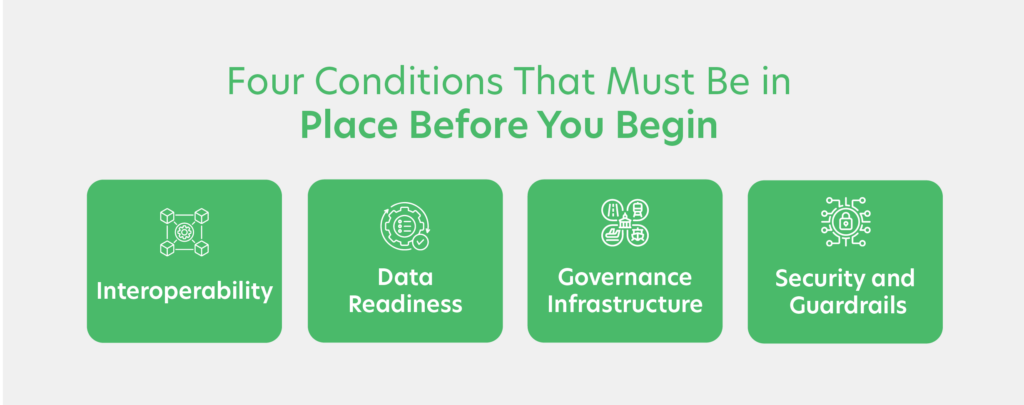
1. Interoperability
An AI agent is only as capable as the system it can access, so before deployment, map every system the agent will need to interact with and assess the integration complexity. The fragmented system architecture is the most common reason technically sound deployments fail to deliver at scale.
2. Data Readiness
Agents operating on poor data produce incorrect outcomes, and incorrect outcomes are more damaging than the manual errors they were meant to replace. It requires that the specific data agent used is sufficiently structured, labeled, and governed for the planned workflow.
3. Governance Infrastructure
The PwC 2026 AI Predictions report states that agentic workflows are spreading faster than governance models can keep pace with. Therefore, enterprises that treat governance as an afterthought discover it only during an incident rather than in planning sessions.
4. Security and Guardrails
AI is becoming increasingly capable of making decisions and taking actions that affect business systems, so strong security measures and guardrails are essential to keep it safe and under control. For instance, giving AI agents excessive access can lead to serious problems, including accidental deletion of critical data. Before deployment, establish access controls, monitoring, and fail-safes so that AI agents can act only within safe limits, protecting sensitive information and maintaining system integrity.
Before any AI automation goes live, define audit-trail requirements, escalation protocols, and the accountability structure.
Enterprises that build this infrastructure before the first deployment find subsequent deployments more efficient and less costly because the governance foundation is already in place.
The Sequencing That Separates AI Leaders From AI Laggards
Enterprises generating returns from AI automation are not just selecting better starting points. They are sequencing their deployments to develop capability rather than just deliver isolated results.
The first deployment should be selected for organizational learning and ROI. This brings challenges to the fore, including operational complexity, data quality gaps, governance requirements, and other dynamics, such as change management.
The second deployment should be informed by what the first one revealed, such as inefficiencies, data issues, and process dependencies, which only become visible once the agent is running in production. In the third, the governance infrastructure should be templated, the integration patterns should be understood, and the internal team should have developed the muscle to move at pace.
Starting Point Is Every Time A Leadership Decision
By Q3 2026, C-suite executives should identify one high-volume, measurable workflow for AI automation deployment, establish governance infrastructure, and assign internal ownership for agentic operations. Organizations that complete these three steps will enter 2027 with a capability advantage. Those who do not will find the gap significantly harder and more expensive to close.
PureLogics has spent over two decades helping enterprises move from strategy to production-grade deployment in AI automation and agentic workflow design. Our work with C-suite executives across healthcare, financial services, retail, and enterprise software has helped them deliver tangible results. If you are ready to define your starting point, begin with 30 minutes consultation with our team.
Frequently Asked Questions
What are the benefits of AI automation?
AI automation reduces operational costs, eliminates manual errors, and speeds up workflows that previously took hours or days. Most importantly, it saves the workforce from repetitive tasks, allowing them to focus on work that actually generates business growth.
What should be the enterprise AI implementation strategy?
Begin with one high-volume, measurable workflow instead of trying to automate everything at once. Secondly, get the data in order, determine the success metrics before deployment, build governance early, and then use what you learn to scale to the next workflow faster and cheaper.
How do we know if an enterprise is ready for AI automation?
If your teams are spending a significant amount of time on repetitive tasks, your data is reasonably structured, and you have at least one workflow with a clear, measurable outcome. It is important to remember that readiness is not about perfect data; it’s about having enough in place to deploy, learn, and improve.