


 [tta_listen_btn]
 May 20 2026

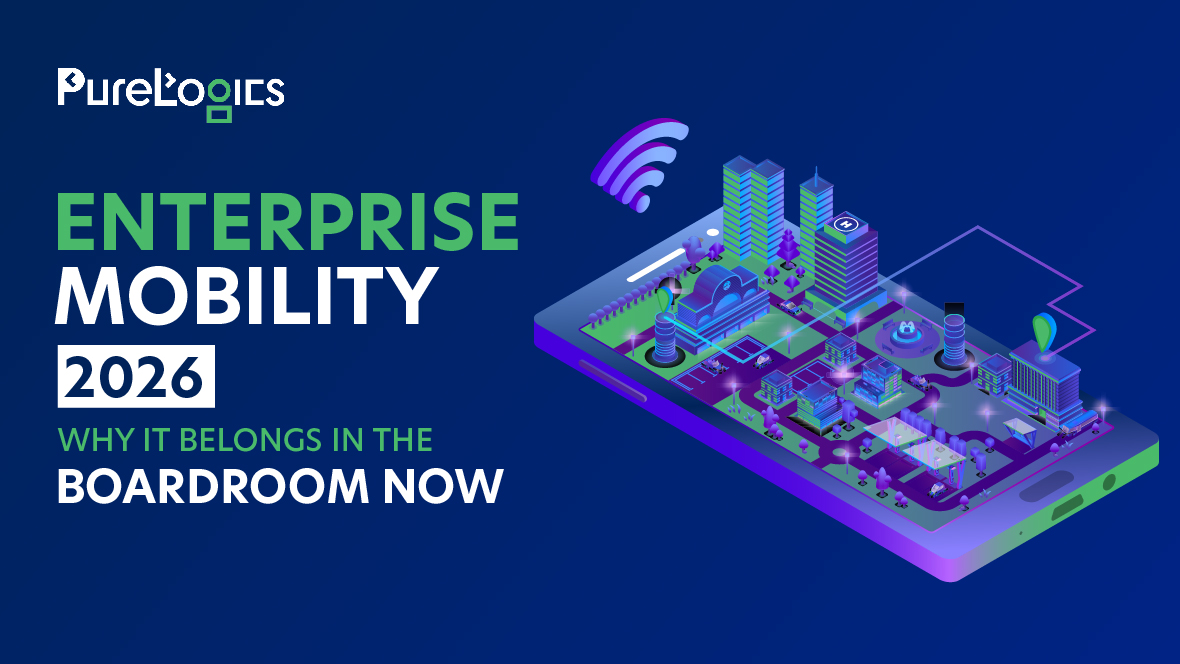
Enterprise mobility is no longer an IT agenda item; rather, it’s a business continuity decision. The executives who treat enterprise mobility management as a back-office concern in 2026 are making the same mistake businesses made with cloud adoption a decade ago, and paying a similar price in lost agility, security exposure, and talent attrition. The workforce has already moved. The question is whether your enterprise architecture has moved with it, securely, intelligently, and at scale.
What follows is why enterprise mobility should be part of boardroom discussions, along with the trends shaping it.
Why Enterprise Mobility Strategy Belongs in the Boardroom Now
As businesses embrace digital transformation and a hybrid workforce, leadership must treat mobility as a boardroom priority to remain agile, competitive, and future-ready. Some more reasons why enterprise mobility belongs in the boardroom are given below:
1. Market Signal Is Unambiguous
According to Gartner’s October 2025 forecast, enterprise mobility trends for 2026 indicate a market that has crossed a critical threshold. Worldwide IT spending is expected to total $6.08 trillion this year. The first time it has exceeded $6 trillion,
A large amount of spending is pulled by one force: the need to support the workforce that operates across devices, locations, and networks that no traditional infrastructure is designed to handle. The 2025 Gartner Market Guide for Managed Mobility Services also captures this trend plainly. The business case for managed mobility has moved decisively from cost control to productivity, talent retention, and employee satisfaction. That is not an IT narrative, but rather an enterprise strategy narrative.
2. Workforce Reality That Cannot Be Ignored
The hybrid and distributed workforce is not a temporary condition. As per the Gartner Mobility Guide mentioned above, the ongoing blend of hybrid, remote, and return-to-office work models is actively generating demand for more flexible and secure enterprise solutions, and that demand is growing. Enterprises that are not actively modernizing their enterprise mobility management frameworks are operating with infrastructure gaps that compound every quarter.
The next question is what is actually driving that modernization push. Increasingly, the answer is AI, and its role inside enterprise mobility is more consequential than most leadership teams have fully accounted for.
3. AI in Enterprise Mobility Is Rewriting How Work Gets Done
Whether it is a tool or an operating system, AI in enterprise mobility has moved well past experimentation. According to Gartner, 88% of businesses now use AI in at least one business function, and that is near universal adoption.
The competitive question has shifted from whether to adopt AI to how quickly it can be embedded across enterprise workflows at scale. As per Gartner’s analysis of the mobility market in 2025, the sector is reshaped by SaaS based innovations, deeper integration of threat intelligence, and breakthroughs in generative AI. All moving towards what Gartner calls autonomous endpoint management (AEM): the ability to automate patch cycles, configuration policy, and anomaly detection without human intervention.
4. The ROI Question Is Real & It’s Widening
The McKinsey State of AI 2025 report identifies a clear performance divide. Businesses that McKinsey classifies as high performers are those capturing enterprise-wide EBITA impact from AI. They are nearly three times as likely to have fundamentally redesigned their workflows in comparison to others who simply deploy AI tools. The implication for enterprise mobility is direct; deploying AI-enabled endpoint management tools without redesigning the workflows around them captures a fraction of the available value.
For a CFO assessing the AI investments in the mobile stack, this is critical framing. The cost of the technology is not the primary variable. The cost of leaving workflow redesign on the table is.
But AI adoption inside the mobile environment introduces a parallel pressure that cannot be managed separately: the attack surface expands as AI capabilities grow. That makes enterprise mobile security not a downstream concern; it is the condition under which everything else either holds or fails.
5. Unified Endpoint Management Is Not a Feature Now
The tendency in enterprise technology is to treat Unified Endpoint Management (UEM). This framework brings mobile devices, laptops, and IoT endpoints under a single management layer, as one component among many.
In 2026, it is not a component. It is the foundation that determines whether everything built on top of it holds. Gartner’s analysis of the enterprise mobility market in 2025 highlights a pattern that is costing businesses in operational overhead that they rarely measure directly. Many enterprises supplement their primary UEM platform with additional point solutions to cover capability gaps. Here, each additional tool adds complexity plus the gap in integration creates a blind spot. The result is an environment that is harder to manage, more expensive to operate, and less visible to the security teams responsible for protecting it.
The decision enterprise leaders need to make is not which UEM vendor offers the best feature set. It is whether the organization’s mobility architecture is integrated tightly enough to deliver real-time control and visibility across the full device estate. That is a different question, and it leads to different procurement criteria.
Furthermore, enterprise mobility management trends show that the real challenge is no longer adoption, but achieving true operational integration at scale.
Enterprise Mobility Management Trends
The three structural forces sculpting the enterprise mobility management trends in ways that will carry through the rest of the decade are below:
- Managed mobility services are increasingly being evaluated on sustainability metrics alongside cost and performance metrics.
- The shift from reactive to proactive operations. AI tools embedded in managed mobility platforms are flagging issues before they surface as employee-facing problems. That shift — from responding to incidents to preventing them — is the operational model enterprise mobility is moving toward.
These structural shifts are already reshaping how enterprises evaluate mobility investments, moving them from operational decisions to strategic infrastructure bets. As the environment becomes more complex, the real differentiator is no longer adoption speed, but architectural readiness for what comes next.
The Cost of Delay Is Now Measurable
The enterprises building durable advantages from their mobility programs today are operating on architectural decisions made two to three years ago, decisions their competitors are now scrambling to replicate. However, the window for first-mover advantage has not closed. But it is narrowing every quarter it stays off the leadership agenda.
We work with enterprise teams across the mobility stack, from environment assessment and security architecture to custom mobile application development, and cloud and mobile enablement. The starting point is not a product recommendation. It is an honest gap analysis between where your mobility infrastructure is today and where your business strategy requires it to be. Scheduling an assessment is the right next step.
FAQs
How is AI influencing enterprise mobility management?
AI is shifting enterprise mobility from manual operations to autonomous endpoint management. It enables automated patching, configuration control, and anomaly detection, but also requires workflow redesign to fully realize ROI and manage increased security risks.
What is the biggest risk if enterprise mobility is not modernized?
The biggest risk is architectural misalignment. Legacy or fragmented mobility systems create security gaps, operational inefficiencies, and poor employee experience. Over time, this leads to higher costs, increased cyber exposure, and reduced organizational agility.
Why is enterprise mobility now considered a business continuity decision instead of just an IT function?
Enterprise mobility now directly impacts agility, security, and workforce productivity. With hybrid and distributed work becoming permanent, mobility architecture determines whether an organization can operate securely and efficiently at scale.