







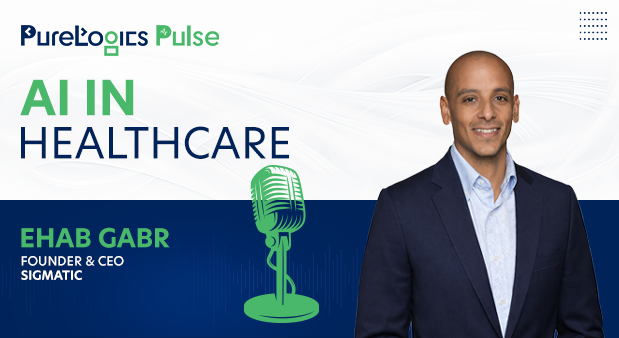
Episode Summary
In this episode of PureLogics Pulse, host Mohsin Ali speaks with Ehab Gabr, CEO of Sigmatic and former innovation leader at Plug and Play Tech Center and Capital Factory. Based in Cedar Park, Texas, Ehab discusses building scalable AI solutions that transform healthcare operations. He shares insights from his journey across healthcare operations, global innovation ecosystems, and startup acceleration, explaining why many AI startups focus heavily on clinical innovation while overlooking operational inefficiencies that healthcare providers face every day.
Ehab also shares lessons from reviewing thousands of startup pitches, emphasizing the importance of collaboration between technologies rather than isolated solutions. The conversation dives into how modern AI platforms can unify fragmented healthcare data from legacy systems while enriching it with real world data collected from physical environments using sensors, computer vision, and ambient intelligence.
Show Notes
- AI in healthcare can create major value by solving operational inefficiencies, not just clinical problems.
- Entrepreneurs must identify who will pay for the solution before building technology.
- Strong startup ideas require both passion for the problem and a large market opportunity.
- Collaboration between multiple technologies often drives larger industry transformation than a single solution.
- Healthcare organizations struggle with fragmented data across multiple legacy systems.
- Combining legacy system data with real world data from sensors and ambient technologies improves accuracy.
- AI platforms can centralize, enrich, and analyze operational data to generate real time insights.
- Human in the loop design is critical for building trust in AI driven decision support systems.
- Healthcare operators prioritize solutions that reduce costs and increase financial performance.
- The future of healthcare AI will depend on scalable platforms that integrate data, automate workflows, and continuously improve operational processes.