







Episode Summary
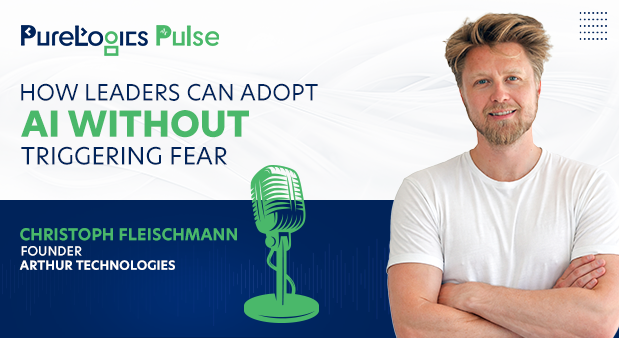
In this episode of PureLogics Pulse, host Amir Khan sits down with Christoph Fleischmann, Founder of Arthur Technologies, to unpack what it truly takes to implement AI without destabilizing teams.
Drawing on his experience building collaborative virtual environments that integrate AI agents directly into the workspace, Christoph explains why most AI anxiety is rooted in uncertainty rather than actual job displacement. He outlines how leaders can reduce fear through clarity, define appropriate boundaries for human decision-making, and position AI as a force multiplier rather than a replacement strategy.
The conversation explores the risks of falling behind in AI adoption, the importance of enterprise-grade guardrails, the role of thoughtful interface design, and the gradual path toward AGI. Through practical insights, Christoph reframes AI from a threat narrative into a leadership opportunity centered on trust, transparency, and long-term value creation.
Show Notes
- AI fear is driven more by uncertainty and lack of communication than by the technology itself.
- Leaders reduce resistance by clearly explaining how AI will be used and what will not change.
- The greater risk is falling behind competitors who effectively leverage AI.
- AI works best as a force multiplier that expands output and ambition rather than as a cost-cutting tool.
- Certain decisions, especially those impacting careers and trust, must remain human-led.
- Hands-on exposure to AI tools reduces anxiety and replaces abstract fear with practical understanding.
- Integrated AI interfaces feel more collaborative than isolated chat-based tools.
- Enterprise adoption requires strong data privacy, security, and clearly defined access controls.
- Transparency about data usage prevents AI from being perceived as surveillance.
- AGI may emerge gradually across domains, making early AI literacy a competitive advantage.