







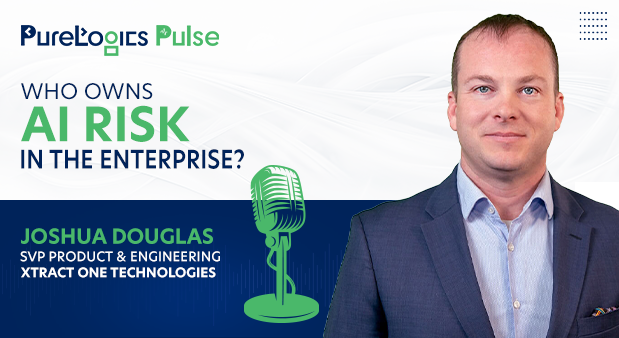
Episode Summary
In this episode of PureLogics Pulse, host Mohsin Ali speaks with Joshua Douglas about the growing challenge of AI risk ownership in enterprises. Drawing on over two decades of experience in cybersecurity, product development, and enterprise transformation, Joshua explains how Xtract One uses AI for weapons detection while maintaining privacy and operational efficiency. He emphasizes that risk management must begin at the architecture level, incorporating threat modeling, data quality checks, and continuous validation. Measuring outcomes such as accuracy, false positives, and false negatives is crucial, especially in high-stakes AI applications.
The conversation also explores common enterprise adoption challenges, including the dangers of moving too fast and the misconception that AI systems are self learning. The episode highlights that AI risk is not just a technical concern but a present-day leadership responsibility, requiring people, processes, and technology to work together for sustainable outcomes.
Show Notes
- AI risk is becoming a leadership responsibility, not just a technical concern.
- Risk management should be embedded into product architecture, not added at the end.
- Successful AI systems rely on high quality training data and continuous validation.
- Enterprises must balance speed of innovation with defined risk tolerance.
- AI models are not self learning and require ongoing human oversight and training.
- Clear metrics such as accuracy, false positives, and false negatives are critical in measuring AI performance.
- AI adoption requires strong governance, often starting at the board and executive level.
- People, processes, and technology must work together to manage enterprise risk effectively.
- Organizations should focus on solving specific problems rather than chasing broad AI potential.
- Customer feedback loops and collaboration play a key role in improving AI systems over time.