


 [tta_listen_btn]
 December 11 2025

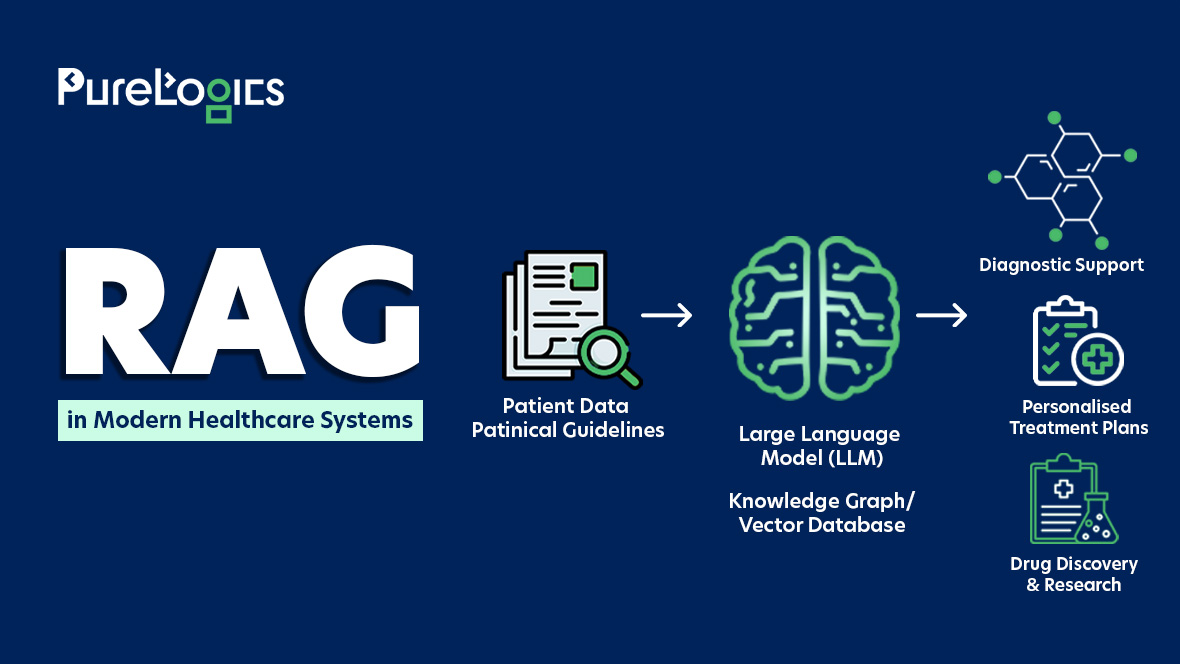
LLMs are powerful and have the potential to augment medical research, patient education, and clinical documentation. But these models can hallucinate, and in healthcare, there is simply no room for that. When lives, diagnoses, and treatment decisions are on the line, every AI-generated insight should be accurate and supported by objective evidence. That’s where RAG comes in, bringing evidence-based AI outputs that help bridge the gap between raw model predictions and precise clinical information. It is high time for healthcare leaders to augment LLMs with RAG to mitigate the hallucination issue because misdiagnosis, underdiagnosis, and overdiagnosis combined can cost 17.5% of total healthcare expenditure. Below is the difference between healthcare systems with or without RAG.
| Without RAG | With RAG |
| Ungrounded hallucination | Grounded on source data |
| Old information | Up-to-date information (citations) |
| Raw data | Comprehensive and detailed |
| Limited to general knowledge only (without access to specific datasets). | Access to both personal and publicly available information |
Recently, a team of researchers in the US developed a context-aware RAG system for the urology domain. That retrieved relevant urological literature and incorporated memory to retain conversational context, and used named entity recognition to filter queries. The results were outstanding:
- 88.5% of AI responses were accurate, context-aware, and clinically safe.
- Reduced hallucination and improved trustworthiness for clinical decision support.
- Performance was validated by board-certified urologists across complicated scenarios.
Let’s face it, healthcare is dynamic, complex, and data-heavy, making it a natural fit for RAG.
Want Results Like These in Your Healthcare System?
Our AI experts can assess your infrastructure and design a custom RAG solution that meets your clinical needs and HIPAA requirements.
What More RAG Can Add to Clinical AI
RAG helps clinical AI to provide precise, evidence-backed insights by connecting to the latest medical knowledge. The other ways in which it can bring value to the healthcare systems are given below:
- Tailored recommendations: It provides recommendations tailored to specific healthcare institutions, referencing local protocols, like treatment pathways and specific care guidelines.
- Audit trails: In addition to citations, RAG systems create audit trails that not only support quality assurance but also help refine the system over time, ensuring it remains a reliable tool for clinical decision-making.
- Diminish bias: RAG helps tackle bias by extracting information from a diverse range of sources. Plus, with the emergence of updated guidelines, RAG systems can incorporate these changes without any need for a complete retraining process. This also ensures that the recommendations clinicians receive are not only reliable but also reflect current evidence.
Another research study conducted by Mayo Clinic demonstrated how RAG enhanced the performance in nephrology and chronic kidney disease (CKD) scenarios. They started with a Large Language Model (LLM), specifically ChatGPT (GPT-4), as the base model. Then connected the LLM to an external knowledge source containing up-to-date medical information specifically aligned with KDIGO 2023 guidelines for chronic disease.
Instead of solely relying on LLM’s pre-trained knowledge, the model could retrieve relevant, authoritative information during query processing. Below is a comparison of responses generated by the RAG-enhanced LLM and ChatGPT.
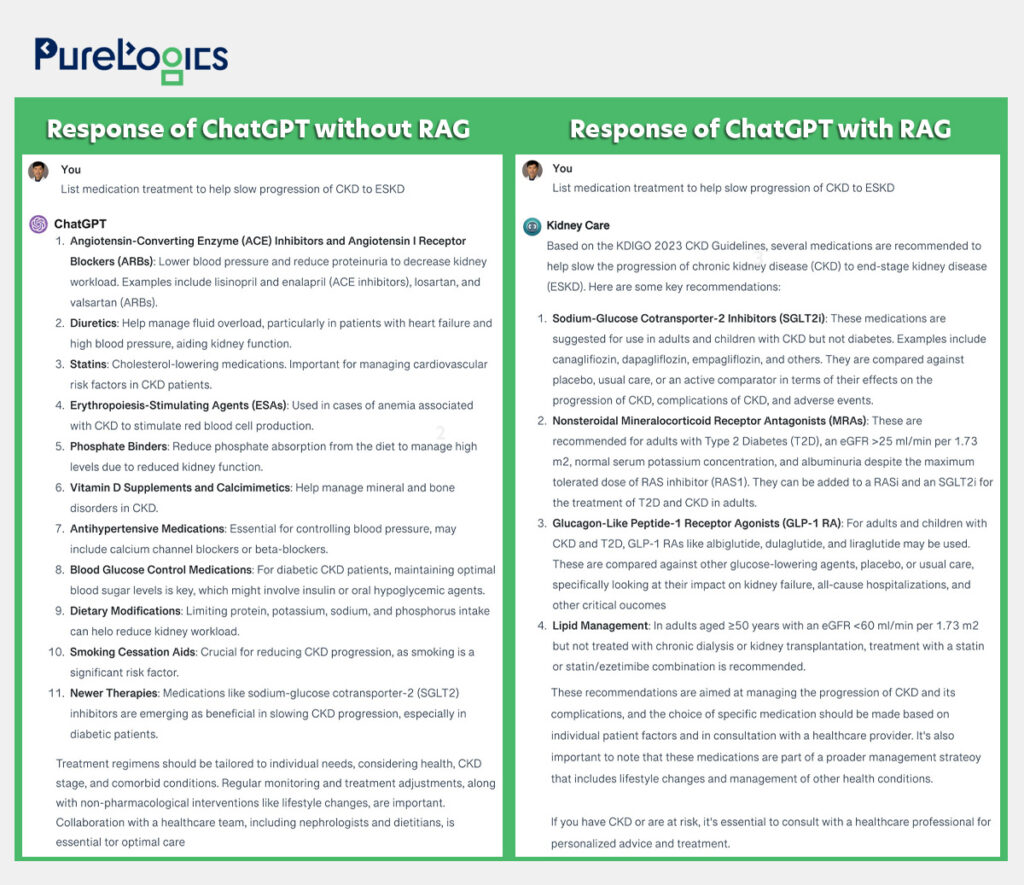
The RAG-enhanced model produced more accurate and relevant outputs than a standard LLM. It followed clinical guidelines for CKD and reduced errors that can happen with generic AI outputs. Because of its accuracy and evidence-based results, healthcare professionals are increasingly relying on RAG to support clinical decision-making.
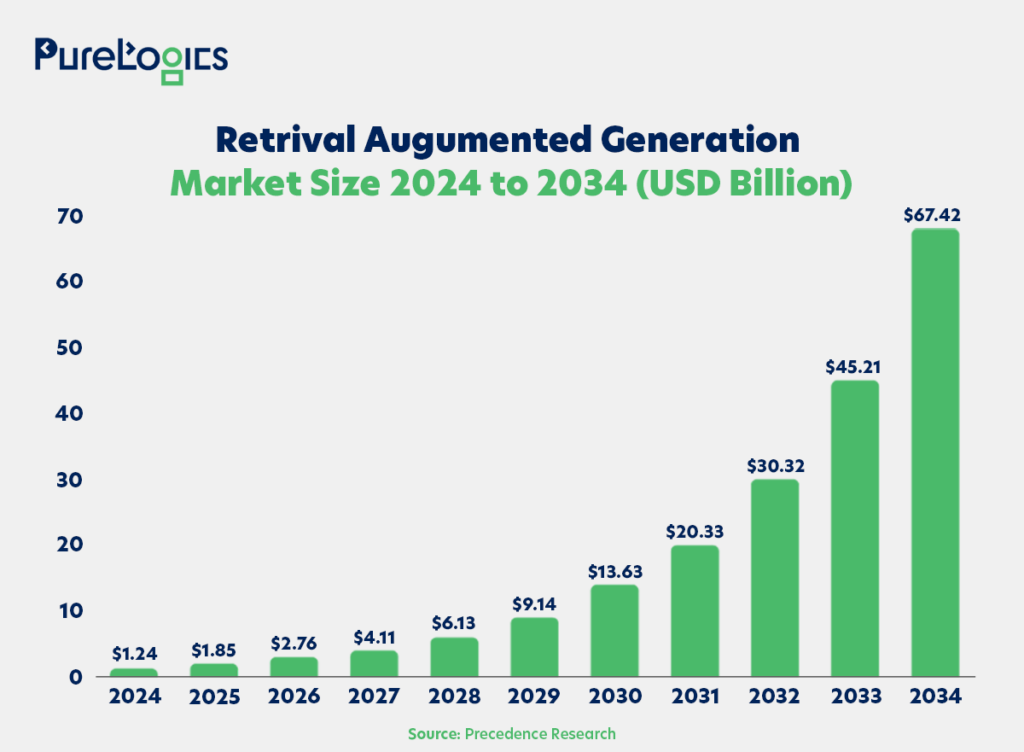
Plus, based on the RAG market trend, Precedence Research predicts rapid growth of RAG over the next decade, reaching $67.42 billion by 2034.
Roadmap for RAG Implementation for Healthcare Executives
Implementing RAG in healthcare systems can be difficult due to data security regulations. But the current road map can give healthcare executives an idea of the timeline and key activities for each phase.
| Phase | Timeline | Key Activities |
| Assessment and Planning | 2–3 months |
|
| Proof-of-concept | 2–4 months |
|
| Data Preparation and Integration | 3–6 months |
|
| Security | Ongoing |
|
| Pilot Deployment | 2–3 months |
|
| Continuous Improvement | Ongoing |
|
Healthcare data contains personal health information, and regulations like HIPAA mandate its careful handling. Moreover, data leakage or non-compliance can result in fines and legal repercussions.
HIPAA Considerations
- Query logs must be encrypted and auditable
- Only medical literature should go into the vector database
- Use on-premises or private-cloud vector databases for PHI queries.
A Road Ahead: RAG’s Future in Healthcare
The use of RAG with predictive analytics enables healthcare providers to access relevant historical data and accurately forecast patient outcomes. Additionally, the RAG could help tailor treatments to an individual’s genetic profile and lifestyle. Moreover, for organizations exploring RAG, conducting a system assessment is key. AI experts cannot only evaluate the system but also develop a plan and determine the best solution to achieve an effective outcome. You can book a 30-minute free consultation with our experts, who have two decades of experience in developing secure, context-aware, and HIPAA-compliant AI solutions.
Frequently Asked Questions
What is RAG in healthcare systems?
RAG in healthcare combines AI with access to relevant medical data, enabling faster, more accurate insights. It can also help predict patient outcomes and personalize treatments based on patient data.
What are the applications of RAG in healthcare?
RAG is used in healthcare for clinical decision support, retrieving accurate medical information, and creating context-aware recommendations. Additionally, it can summarize extensive health records for faster decision-making and provide medical documentation support.
How does RAG improve healthcare accuracy?
RAG enhances healthcare accuracy by grounding AI responses in verified medical data rather than relying solely on the model’s memory. It retrieves the most relevant clinical medical guidelines, research papers, and patient records. Then it generates the answers strictly from that information, reducing hallucinations and ensuring alignment with up-to-date medical evidence.